The world’s first “phase change ink” can achieve passive temperature control
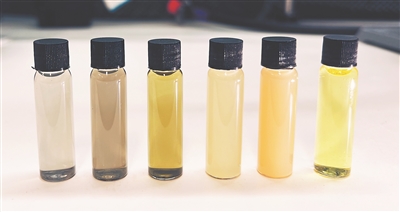
Science and Technology Daily, Beijing, March 28th (Reporter Zhang Jiaxin) – Researchers at the University of Melbourne in Australia have developed the world’s first “phase change ink” that can change the heating and cooling methods of houses and cars. It can achieve complex “passive climate” control and has great potential to help reduce energy consumption and global greenhouse gas emissions. The research was published in the latest issue of the Royal Society of Chemistry’s Journal of Materials Chemistry A.
Research leader Dr. Mohammad Taha stated that these inks can be used to develop coatings for passive heating and cooling.
Passive climate control methods can create comfortable living conditions and reduce unnecessary energy consumption. For example, in order to provide heating in winter, the ink on the building facade can automatically switch to allow for more solar radiation during the day and better insulation at night to keep warm. In summer, they can form a barrier to block thermal radiation from the sun and surrounding environment.
The multifunctional “phase change ink” that uses nanotechnology to control daily environmental temperature is a proof of concept that can be laminated, sprayed, or added to paints and building materials. It can also be integrated into clothing to regulate body temperature in extreme environments, or used to manufacture large, flexible and wearable electronic devices such as flexible circuits, cameras and detectors, as well as gas and temperature sensors.
Taha said that the new research means that existing structures and building materials can be renovated, and this ink is likely to be launched on the market within 5 to 10 years. Through cooperation with the industry, it can also be scaled up and integrated into existing new technologies as a solution to address the challenges of global climate change.
This breakthrough was achieved by discovering how to modify vanadium dioxide, one of the main components of phase change materials. Phase change materials use thermal or electrical triggers to create enough energy for the material to self transform under pressure. Previously, phase change materials needed to be heated to very high temperatures to activate their phase change properties.
Dr. Taha’s team tested how they triggered the reaction of insulator metal phase transition, in which the new material acted as a switch, preventing heat above a specific temperature.
Researchers say that the new material can adjust its heat absorption performance as needed, which means smarter bricks and paints can be designed.
Copyright @ 2026 Guangdong Qihe Cai Ink Co., Ltd ICP Record Number:粤ICP备2022064656号

Scan the code to follow us
(Long press to recognize QR code)